
Study in GermanyBuild Your Global Future with €0 Tuition
Germany offers international students a strong combination of established universities, research opportunities, practical education, and access to Europe's largest economy. Experience world-renowned TU9 technical excellence with low or no tuition fees.

Blocked Account (€11,904) & EU Blue Card Pathway
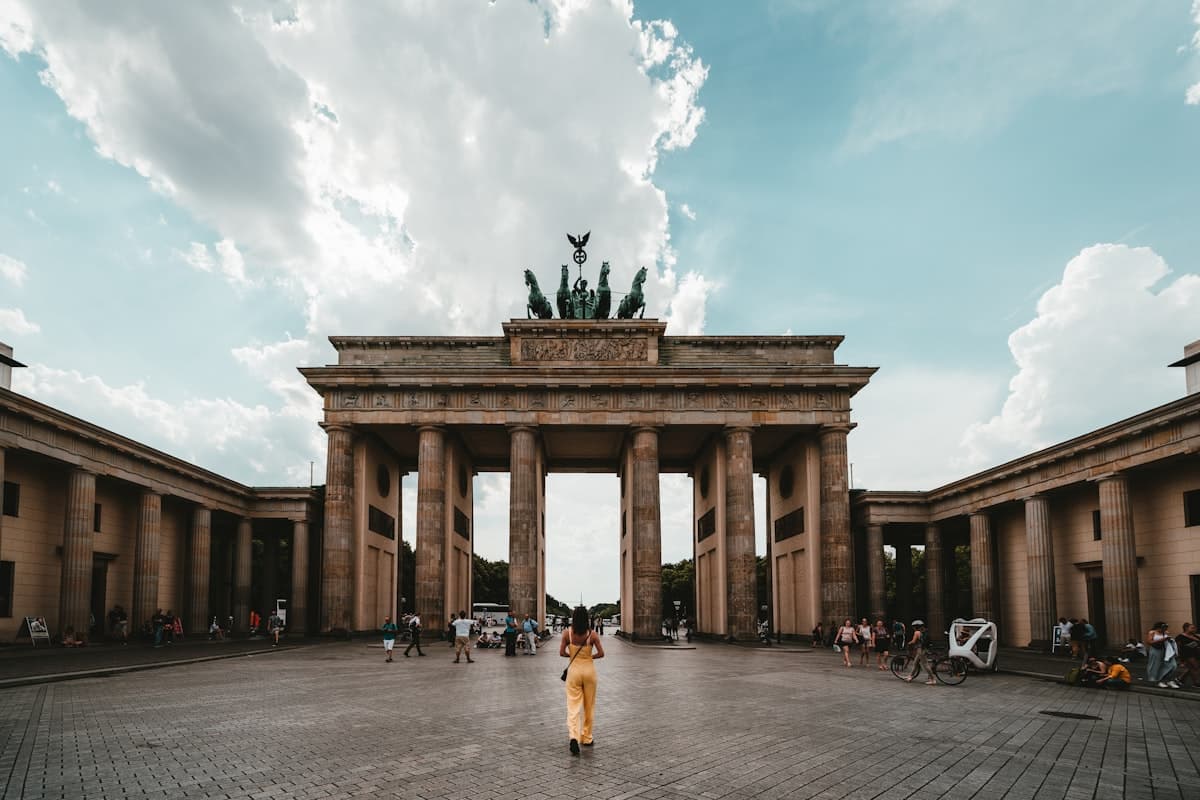
Historic Brandenburg Gate
At the crossroads of European history, cutting-edge technology, and innovation
About Germany & Its World-Class Higher Education
Located in Central Europe and an anchor member of the European Union, Germany is renowned globally for its powerhouse industrial economy, world-class research institutes, and unmatched leadership in engineering, automotive technology, and applied computer sciences.
Top Courses in Germany for International Students
Germany's curriculum bridges rigorous theoretical fundamentals with hands-on industrial research in global manufacturing and software ecosystems.
Computer Science & IT
Top European tech education with elite research in algorithms, distributed systems, cybersecurity, and direct industry integration in Munich and Berlin.
Engineering & Technology
World-famous German engineering rigor recognized globally under the Washington Accord across TU9 polytechnics and applied universities.
Artificial Intelligence & Data Science
Cutting-edge machine learning, computational neuroscience, and big data systems supported by federal AI research clusters and Cyber Valley.
Business & Management
Equis/AACSB accredited degrees in international management, supply chain, and finance located in Europe's most powerful manufacturing and trading economy.
Mechanical & Automotive Engineering
Home to the automotive pioneers: BMW, Mercedes-Benz, Porsche, Volkswagen, and Audi. Leading programs in EV powertrain, aerodynamics, and lightweight design.
Electrical Engineering
Pioneering microelectronics, semiconductor manufacturing (Silicon Saxony), telecommunications, and smart electrical grids.
Natural Sciences
Nobel Prize-winning heritage across physics, chemistry, and molecular biology with direct access to Max Planck and Helmholtz institutes.
Renewable Energy & Environmental Sciences
Germany leads Europe's Energiewende (energy transition), offering elite degrees in wind power, solar photovoltaics, and sustainable resource management.
Medicine & Life Sciences
Rigorous medical state examination (Staatsexamen) pathways and English-taught Master's in molecular medicine, pharmacology, and bioinformatics.
Why Study in Germany?
Germany provides international students with a broad range of academic and career-oriented opportunities across Europe's leading tech ecosystem.
Tuition-Free Public Universities
Most public universities charge €0 tuition for undergraduate and consecutive master's degrees, requiring only a modest semester contribution.
TU9 & Elite Research Hubs
Germany is home to the TU9 alliance and German Universities of Excellence, collaborating directly with Max Planck, Fraunhofer, and Helmholtz institutes.
18-Month Job-Seeking Visa
Graduates are granted an 18-month residence permit to secure qualified employment, bridging effortlessly into an EU Blue Card or skilled worker permit.
Work 140 Full Days / Year
International students can legally work up to 140 full days (or 280 half-days) per calendar year or 20 hrs/week, earning statutory minimum wages of €12.41+/hr.
Europe's Largest Economy
Global headquarters of BMW, Siemens, SAP, Bosch, Mercedes-Benz, BASF, and Bayer providing unmatched paid working student (Werkstudent) jobs.
English-Taught Programs
Over 2,000+ accredited international master's and bachelor's programs taught completely in English without initial German proficiency.
Fast-Track Permanent Settlement
German university graduates can apply for a permanent settlement permit (Niederlassungserlaubnis) after just 21 to 27 months of employment.
Central European Schengen Gateway
Bordering 9 countries, your German student visa grants visa-free travel throughout all 29 Schengen member states.
Work Up to 140 Full Days Per Year
International students from outside the EU can work up to 140 full days or 280 half-days per calendar year. Alternatively, you can work up to 20 hours per week during the lecture semester and full-time during breaks. Many students secure paid “Werkstudent” internships at BMW, Siemens, or SAP.
18-Month Job-Seeking Residence Permit
After completing your degree, you can apply for an 18-month residence permit to search for graduate employment. Once hired, you transition directly to an EU Blue Card or skilled worker permit, qualifying for permanent settlement (Niederlassungserlaubnis) in as little as 21 months.
Germany Student Visa Process: 8-Step Roadmap
From APS certification and Uni-Assist to your €11,904 blocked account and visa grant, Umang Career Consultancy guides you through every milestone.
Choose Your University & Program
Shortlist suitable German universities (TU9, Excellence Universities, or Applied Sciences) according to your academic profile, budget, and career goals.
Apply for Admission
Prepare certified academic transcripts, syllabus translations, motivation letter (Motivationsschreiben), and submit via Uni-Assist or direct university portals.
Receive Your Admission Letter
Once accepted, obtain your official university admission document (Zulassungsbescheid) confirming your enrollment terms.
APS Certificate Verification
For applicants from India, APS certification is mandatory. We provide complete documentation review and submission guidance for the Academic Evaluation Centre.
Arrange Financial Proof (€11,904)
Open an approved German Blocked Account (Sperrkonto) with €11,904 for one year (with monthly withdrawals limited to €992) via Expatrio, Coracle, or Fintiba.
Statutory Health Insurance
Arrange mandatory German statutory student health insurance coverage (Techniker Krankenkasse - TK, AOK, or Barmer) for the entire duration of your stay.
Submit Your Visa Application
Complete your VIDEX national visa application, document audit, and biometric appointment at the German Embassy / Consulate or VFS center in India.
Travel & City Registration (Anmeldung)
Fly to Germany, complete city hall address registration (Anmeldung), activate your blocked account, and collect your biometric residence permit (Aufenthaltstitel).
Popular Student Cities in Germany
Each German city offers distinct economic hubs, campus cultures, living costs, and corporate recruitment opportunities.
BERLIN
Germany's vibrant capital, famous for a booming venture-backed tech scene, rich Cold War history, endless cultural diversity, and world-class universities.
MUNICH
Home to BMW, Siemens, Allianz, TUM, and LMU. Breathtaking Bavarian alpine lifestyle paired with Germany's highest density of engineering and tech jobs.
HAMBURG
A stunning canal-lined international trading center with strong logistics, aviation engineering (Airbus), renewable energy, and vibrant student music quarters.
FRANKFURT
Skyscraper metropolis housing the European Central Bank and Deutsche Bundesbank. Center for international banking, FinTech, and European trade fairs.
AACHEN
Located where Germany, the Netherlands, and Belgium meet. Dominated by RWTH Aachen polytechnic students, electric vehicle spin-offs, and robotics labs.
HEIDELBERG
Germany's oldest university city nestled on the Neckar River, celebrated for red sandstone castle ruins, world-famous cancer research centers, and biotechnology.
Top Universities & Institutions in Germany
Umang Career Consultancy can help students compare institutions based on course, academic profile, tuition, location and career goals.

Technical University of Munich (TUM)
Munich, BavariaSpecializations: Computer Science, Mechanical Engineering, AI, Electrical Systems

LMU Munich (Ludwig Maximilian University)
Munich, BavariaSpecializations: Medicine, Natural Sciences, Business Administration, Humanities

Heidelberg University (Ruprecht Karls)
Heidelberg, Baden-WürttembergSpecializations: Medicine (MD), Physics, Molecular Biology, Law, Humanities

RWTH Aachen University
Aachen, North Rhine-WestphaliaSpecializations: Mechanical & Automotive Engineering, Metallurgy, Electrical Eng

Humboldt University of Berlin (HU Berlin)
Berlin (Capital)Specializations: Computer Science, Philosophy, Economics, Environmental Sciences

Free University of Berlin (FU Berlin)
Berlin (Capital)Specializations: Social Sciences, Political Science, Global Economics, Life Sciences

Karlsruhe Institute of Technology (KIT)
Karlsruhe, Baden-WürttembergSpecializations: Computer Science, Energy Systems, Nanotechnology, Mechanical Eng

Technical University of Berlin (TU Berlin)
Berlin (Capital)Specializations: Civil & Environmental Engineering, Architecture, Data Analytics

University of Freiburg
Freiburg, Baden-WürttembergSpecializations: Renewable Energy, Biotechnology, Forestry, Medicine

University of Bonn
Bonn, North Rhine-WestphaliaSpecializations: Mathematics, Quantitative Economics, Agricultural Sciences, Physics
Germany Tuition Fees
Germany's tuition structure varies by university, state, program and student status. Many public universities do not charge general tuition fees for bachelor's and consecutive master's programs, although semester contributions apply.
| Study Level | Indicative Tuition (€ EUR) |
|---|---|
| Bachelor's Degree | Often €0 tuition at public universities (semester contribution ~€150–€350 applies) |
| Master's Degree | Often €0 at public universities for consecutive programs (exceptions e.g. Baden-Württemberg €1,500/sem) |
| Private Universities | €5,000 – €20,000+ per year |
| PhD / Doctoral Studies | Generally no tuition at public universities (often salaried research posts) |
| Main Intakes | Winter Semester (Sept/Oct - Major) & Summer Semester (March/April) |
*Fees may vary depending on university, course and intake.
The German Missions in India state that students must demonstrate sufficient financial funds through a blocked account of €11,904 for one year, with monthly withdrawals limited to €992 per month upon arrival in Germany.
Monthly Cost of Living
Living costs depend on the city, accommodation type and lifestyle. Munich and Frankfurt have higher rental rates, while student cities like Aachen, Leipzig, or Bonn offer great savings.
Studentenwerk dorms average €280–€420/mo; shared flat rooms (WG-Zimmer) range €400–€750/mo depending on city.
Supermarkets (Aldi, Lidl, Rewe, Edeka) and subsidized university Mensa cafeterias (€3–€5/meal).
Universities provide a Semesterticket (or Deutschlandticket upgrade) offering regional/national transit access.
5G prepaid SIMs (Telekom, Vodafone, O2) and high-speed fiber broadband.
Warm rent often includes heat/water; Rundfunkbeitrag (TV license) is €18.36/mo per apartment.
Campus sports (Hochschulsport), weekend museum visits, alpine hiking, and cafes.
Weather in Germany: Four Distinct Seasons
International students experience the beauty of Central Europe through all four distinct seasons, from sunny beer garden summers to fairytale winter Christmas markets.
Summer
Pleasantly warm and sunny across Germany. Perfect for outdoor riverbank festivals in Berlin, beer gardens in Munich, and lakes in Bavaria.
Autumn
Golden foliage across historic campuses and Black Forest hills. Mild, crisp weather marking the kickoff of the major Winter Semester.
Winter
Magical fairy-tale snowy spires, world-famous Christmas markets (Weihnachtsmärkte), glühwein, and budget ski resorts in the Bavarian Alps.
Spring
Cherry blossoms bloom along Bonn's historic avenues. Fresh sunny days return as outdoor campus events and student sports resume.
Frequently Asked Questions About Studying in Germany
Clear, transparent answers regarding €0 tuition, APS certification, blocked accounts, 18-month stay-back visas, and permanent residency.
Start Your Study Journey in Germany
Get personalized guidance for public university selection, Uni-Assist applications, APS documentation, blocked accounts, and your Germany student visa.